
Carpenter Marketing in Jacksonville and St. Augustine: A Practical Guide to Getting Found Online
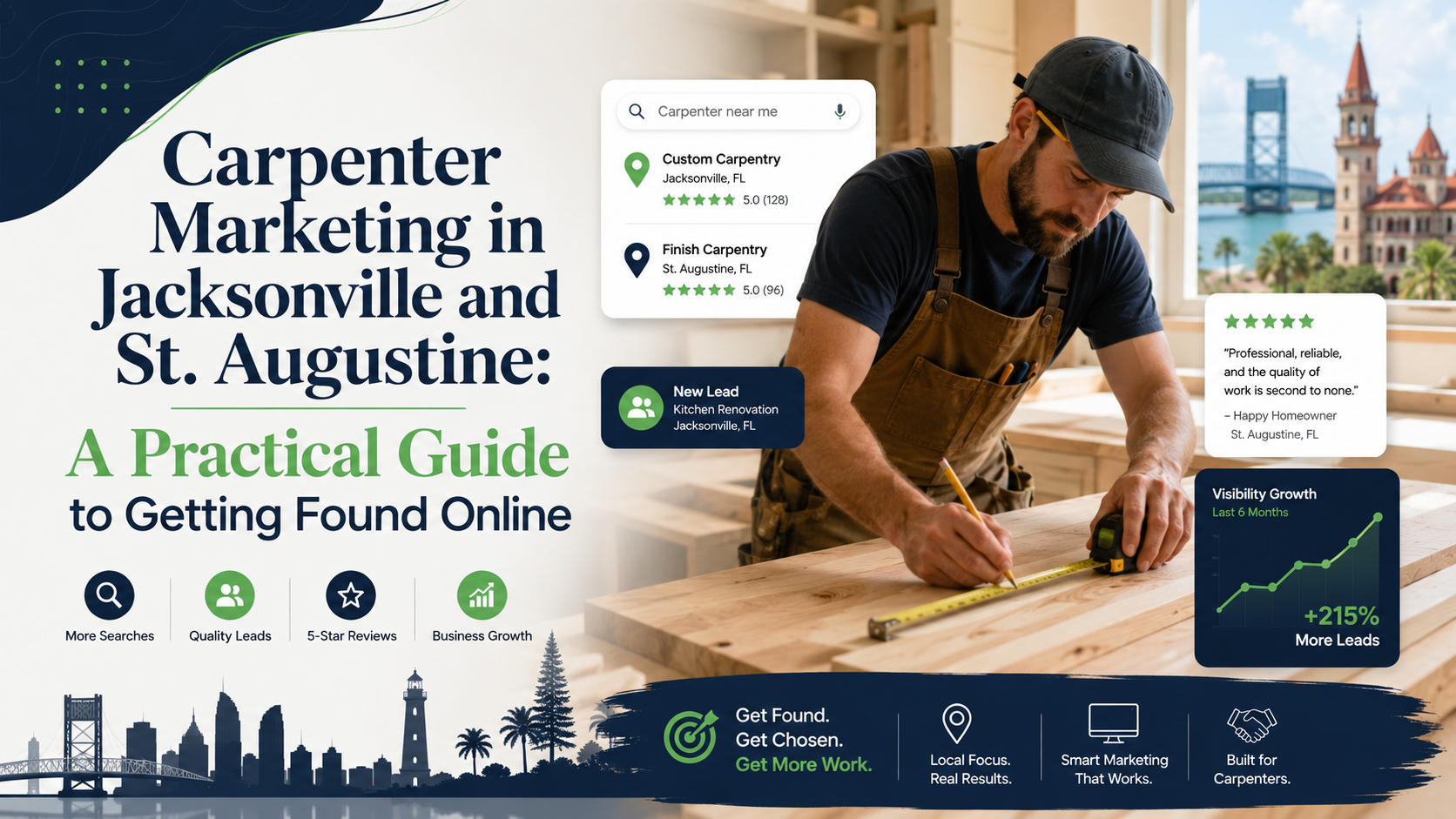
How carpenters in Jacksonville and St. Augustine build an online presence that turns local searches into booked custom cabinet and trim jobs.
Most carpenters get work the same way for years. A builder calls, a past client refers a neighbor, and the calendar fills. That works until it does not. When a slow stretch hits, or when you want bigger custom cabinet and millwork jobs instead of small punch-list work, you need people to find you when they go looking. In Northeast Florida, that means showing up online for the searches homeowners are already typing.
This guide walks through how to build that online presence, with specifics for cabinet, trim, and finish carpentry work in the Jacksonville and St. Augustine market.
Why a strong online presence matters for carpenters here
Carpentry is a high-trust, high-dollar purchase. A homeowner spending real money on custom cabinets or built-ins wants to see your work and feel confident before they call. Many of them start on their phone, look at photos, read a few reviews, and decide who to contact in a single sitting.
This area also has two very different kinds of customers, and both look for you online.
In Riverside, Avondale, Springfield, and the historic core of St. Augustine, you have older homes with original millwork, plaster, and trim profiles that big-box installers cannot match. Owners of those homes search specifically for craftsmen who understand historic work.
In Nocatee, World Golf Village, Fruit Cove, and the newer St. Johns County builds, you have growing families who closed on a house and now want built-ins, a custom closet system, a trimmed-out office, or cabinets that fit how they actually live. They search too, and they often compare a few names before reaching out.
If you are not visible to either group, you are leaving the better jobs to whoever is.
The services your website should show off
Vague pages lose work. A homeowner who wants crown molding does not feel confident hiring a site that only says “carpentry services.” Spell out what you do, and give each major service room to breathe.
Concrete services worth featuring:
- Custom cabinets and cabinet refacing
- Built-in shelving, bookcases, and entertainment centers
- Crown molding, baseboards, casing, and decorative trim
- Interior door installation and hardware
- Closet and storage systems for bedrooms, pantries, and garages
- Wainscoting and board-and-batten accent walls
- Stair treads, risers, and railing work
- Custom millwork and one-off pieces
- Historic millwork restoration and trim matching
Each of these can become its own page over time. A standalone page on cabinet refacing, for example, lets you explain when refacing makes sense versus full replacement, show before-and-after photos, and rank for people searching that exact term.
Photos do more selling than words in this trade. Clean, well-lit shots of finished work, ideally with a short note on the home or neighborhood, build belief faster than any paragraph.
How local customers actually search
People rarely search the way you describe your business. They search by the thing they want plus where they are. Your pages should match that language.
Common patterns in this market:
- custom cabinets Jacksonville
- finish carpentry St Augustine
- trim carpenter near me
- built-in shelving Jacksonville
- cabinet refacing Mandarin
- closet systems Ponte Vedra
- historic trim restoration St Augustine
The winning move is pairing a service with a place. “Custom cabinets Mandarin,” “built-ins Nocatee,” “finish carpenter Ponte Vedra Beach,” and “millwork restoration Springfield” are all realistic searches that a service-plus-neighborhood page can target. You do not need a page for every street. You need pages for the services you most want, and a handful of area pages for the neighborhoods where your best work lives.
Website essentials that win finish-carpentry jobs
Your site has one job: make it easy for a ready buyer to trust you and reach you. A few things matter more than design polish.
Mobile first. Most local searches happen on a phone. If your site is hard to read or slow on a small screen, people leave before they see your work.
Tap-to-call and a short form. Make your phone number tappable on every page. Add a simple contact form for people who would rather type than call, especially homeowners researching after hours.
Fast load. Big, uncompressed photos are the usual culprit on carpenter sites. Compress your images so galleries load quickly. A slow site loses patient-zero customers who would have called.
Trust signals. State that you are licensed and insured. Show years in business, the areas you serve, and a few real reviews near the top. For finish work, a tight portfolio organized by type, cabinets, trim, built-ins, stairs, does a lot of quiet convincing.
Setting up and using your Google Business Profile
For local trades, your Google Business Profile is often the first thing people see, and sometimes the only thing they need before calling. Claim it, fill it out completely, and keep it active.
A few specifics that help carpenters:
- Choose the most accurate primary category, then add related ones such as cabinet maker, carpenter, or finish carpentry where they apply.
- List your service area by the towns and counties you cover, Duval, St. Johns, Clay, and Nassau as relevant, rather than relying on a single pin.
- Add photos often. Fresh project photos signal an active business and give Google more to show.
- Use the services and description fields to name your actual work in plain words.
- Answer questions and respond to every review.
Posting occasional updates with new project photos keeps the profile fresh and gives returning searchers something current to look at.
Local search (SEO) and neighborhood pages
Local search (SEO) is mostly about being clear, consistent, and genuinely local. Keep your business name, address, and phone number identical everywhere they appear online. Earn mentions and links from local sources where it makes sense, a neighborhood association, a supplier, a builder you work with.
Service-area and neighborhood pages are where many carpenters gain ground. A page about finish carpentry in San Marco can speak to the older homes there and the trim styles common to them. A page on built-ins for Nocatee can speak to new-construction layouts and storage for growing families. The key is that each page must be real and useful. Thin pages that just swap the town name help no one and can hurt you. Write each one as if a homeowner in that area is the only reader.
Reviews and reputation for a craft trade
Reviews carry extra weight when the work is permanent and visible. Ask every satisfied client for a review while the job is fresh in their mind, ideally right after the final walkthrough when they are looking at the finished piece.
Make it easy. Send a direct link by text. Respond to every review, good or critical, in a calm and professional tone. A thoughtful reply to a hard review often reassures future customers more than a wall of five-star ratings.
Photos attached to reviews are gold for a visual trade. When a client posts a picture of their new built-in alongside their words, future buyers see proof and praise together.
Showing up in AI search and Google AI answers
More people now ask an AI assistant or read Google’s AI summary instead of scrolling through links. These tools pull from clear, well-structured content and from your business information across the web.
To improve your odds of being included:
- Write pages that answer real questions plainly, such as the difference between cabinet refacing and replacement, or how to match historic trim.
- Keep your business details consistent everywhere, since AI tools lean on that consistency to decide who is real and local.
- Use clear headings and straightforward language. Content written for a human to skim is also easier for these systems to summarize.
The same habits that help you rank in normal search, clarity, consistency, and genuine local detail, are what help you surface in AI answers.
Paid ads when you want to fill the calendar
Organic visibility takes time to build. Paid ads can bring leads sooner, which matters during a slow stretch or when you launch a new service.
Google Ads works well for high-intent searches like “custom cabinets Jacksonville,” because the person is actively looking. Meta ads on Facebook and Instagram work differently. They are visual, so they suit before-and-after content and reach people who are not searching yet but might want a project. For a craft trade, the photo-driven nature of Meta can showcase your work to homeowners in specific areas.
Start with a modest, controlled budget, point ads at your most profitable services, and track which calls turn into jobs. Spend more on what books work and cut what does not. The goal is profit per job, not clicks.
Seasonal timing for carpenters in Northeast Florida
Interior carpentry is less weather-bound than outdoor trades, which is an advantage you can market around. When summer heat, humidity, and afternoon storms push outdoor projects, interior cabinet, trim, and built-in work keeps moving.
A few timing patterns to plan around:
- The stretch before the holidays brings homeowners who want a kitchen refaced or built-ins finished before guests arrive. Demand for visible interior work tends to rise.
- New-construction closings in St. Johns County happen year-round, and new owners often want built-ins and storage soon after moving in.
- After hurricane season, some interior repair and trim replacement work follows water and storm damage, which can pair with restoration carpentry.
Adjust your ads and your homepage message to match what people want in that part of the year.
Common mistakes to avoid
- Hiding your work. A carpenter without a strong photo gallery is invisible in a visual trade.
- One generic services page. Break out your main services so each can rank and reassure.
- An unclaimed or stale Google Business Profile. This is often the single biggest missed opportunity.
- Ignoring reviews. Silence reads as either inattention or something to hide.
- Thin neighborhood pages. Make each area page genuinely about that area or skip it.
- Inconsistent business details across the web. Mismatched names or numbers confuse both customers and search tools.
Good carpentry sells itself once people can see it. The hard part is getting in front of the right homeowners in Jacksonville, St. Augustine, and the surrounding counties at the moment they are looking.
Grow Local Flow works with home service businesses across Northeast Florida to build websites, profiles, and local visibility that fit how customers actually search. Reach out when you are ready for a straightforward conversation about what would work for your shop.
You may also like our post on Home Service Professionals Marketing in Jacksonville and St. Augustine: A Playbook Any Trade Can Use
About the Author: Chuck Anderson is the founder of Grow Local Flow and spent more than 20 years leading transformation and digital initiatives at JPMorgan Chase before launching Grow Local Flow to help Jacksonville and St. Augustine small businesses improve their online visibility.
Simple, Transparent pricing | locally owned & operated
Local Visibility Services for Jacksonville, St Augustine & St Johns County Small Businesses
Get found on Google, Google Maps, and AI search tools like ChatGPT, and turn that visibility into calls and customers. As a local St. Johns, FL business, we understand the market, the community, and what local customers are looking for. Plain-English plans, no long term contracts.
Get found on Google, Google maps, and AI search tools like ChatGPT.
Starting at $299/mo
Show up in Google results and maps where local customers are searching.
$299 Setup & optimization
Mobile-first, conversion-focused websites built to turn visitors into leads.
$199 + $89/mo hosting
See where you stand on Google and if AI tools like ChatGPT find you.