What Is GEO and How Can a Jacksonville or St. Augustine Small Business Use It in 2026?
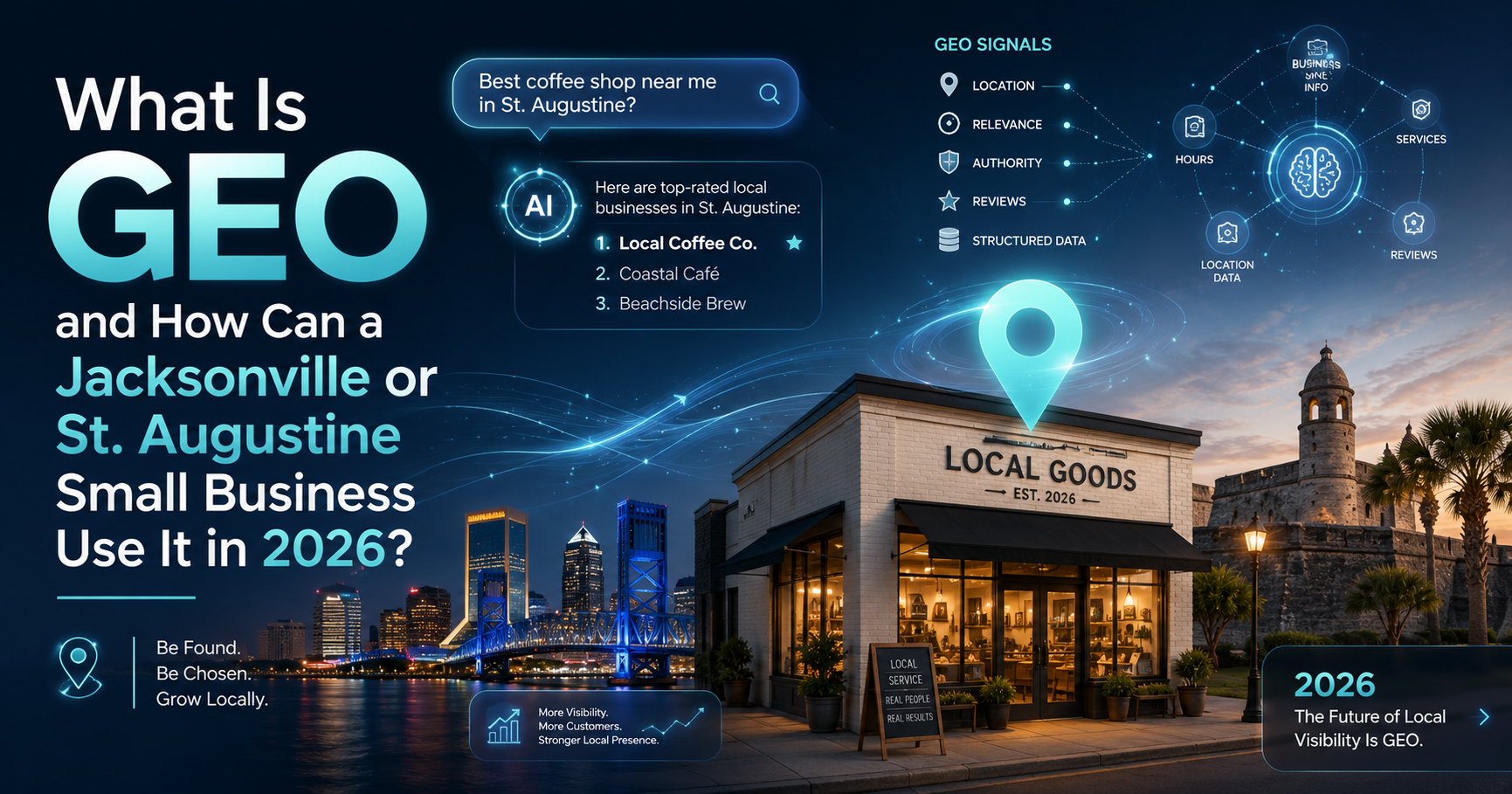
How to Show Up in ChatGPT, Perplexity, and Google AI Overviews
If you run a local business in Jacksonville, St. Augustine, or anywhere across St. Johns County, the way customers find you is changing fast.
Five years ago, the question was "How do I show up on Google?"
Today, it's also "How do I show up when someone asks ChatGPT for a recommendation?"
That second question has a name. It's called GEO or Generative Engine Optimization. And most local business owners have never heard of it, which means right now, in 2026, there's a window of opportunity that won't stay open long.
This guide explains what GEO actually is, why it matters for a contractor, restaurant, or service business in Northeast Florida, and the practical steps you can take this week — without hiring an agency, without a technical degree, and without spending a dollar.
What Is GEO?
Generative Engine Optimization (GEO) is the practice of structuring your business information so that AI tools like ChatGPT, Perplexity, Google AI Overviews, Gemini, and Microsoft Copilot can find you, understand what you do, and recommend you when someone asks them a question.
You may also see it called:
- AEO (Answer Engine Optimization)
- LLM SEO ( Large Language Model SEO)
- AI Search Optimization
They all mean essentially the same thing. The industry hasn't settled on one term yet, but the concept is the same: optimize for AI, not just for Google's old blue links.
Why GEO Matters Now (Not Next Year)
Three things changed in the last 18 months that small business owners need to know:
- AI Overviews now appear on the majority of local searches. A recent industry analysis found that AI Overviews appear on roughly 68% of local business queries in 2026. That means when someone searches "best roofer in Jacksonville" or "AC repair near me," the first thing they see is an AI-generated answer, not the traditional list of websites.
- AI tools recommend businesses by name. When you ask ChatGPT, "Who's a good plumber in St. Augustine?", it gives you actual business names. If your business isn't in its answer, the customer never knows you exist. There's no second page to click to.
- Customers are using AI for real decisions. A growing share of consumers, especially under 45, now ask ChatGPT, Perplexity, or Google AI before calling a local business. They're not browsing search results anymore. They're asking for a recommendation and acting on it.
If your business isn't visible to these AI tools, you're slowly going invisible to a growing chunk of the market.
How Is GEO Different from Regular SEO?
Traditional SEO (search engine optimization) is about ranking on Google's search results page, those blue links you scroll through.
GEO is about being cited inside an AI's answer. The mechanics are different in three important ways:
Traditional SEO
- Goal: rank #1 on Google
- Keywords matter
- Backlinks are king
- Click-through rate
- Pages compete for ranking
Generative Engine Optimization (GEO)
- Goal: be named in the AI's answer
- Natural-language questions matter more
- Citations from trusted sources are king
- Citation rate (do AI tools mention you?)
- Sources compete for inclusion
The good news: a lot of what works for traditional SEO also helps GEO. The differences are in the details, and the details are where most small businesses are getting left behind.
The 7-Part GEO Checklist for a Local Business
Here is the entire playbook, in plain English. You can do most of this yourself in a single weekend.
1. Claim and fully complete your Google Business Profile
This is non-negotiable. AI tools, including ChatGPT, when it pulls in current data, heavily rely on Google Business Profile (GBP) for local recommendations.
What "fully complete" means:
- Verified profile (not just claimed — verified by phone, postcard, or video)
- The right primary category (be specific — "Roofing contractor," not just "Contractor")
- 2–3 secondary categories that match what you actually do
- Complete service list with descriptions (not just service names)
- Service area set to the exact cities and neighborhoods you serve
- Hours, phone, website, and address all matching what's on your own website
- At least 10 photos uploaded to your main Photos library (more is better)
- Weekly Google Posts with photos
- 5+ Google reviews from real customers
If you're a contractor with no storefront, set your business type to "Service area only" and list every neighborhood you actually drive to.
2. Add LocalBusiness schema to your website
This is the single most powerful technical change you can make. Schema markup is hidden code that tells AI tools exactly what your business is, where it is, and what it does — in a structured format machines can read with certainty.
What you need:
- Business name (exactly as it appears on Google Business Profile)
- Address (or service area if you don't have a storefront)
- Phone in E.164 format (e.g., +19043358594)
- Hours
- Areas served
- Services offered
- Price range (use $, $, or $$$$)
- URL of your website
- Logo URL
This goes in the <head> of your homepage as JSON-LD code. If you use WordPress, plugins like Rank Math or Yoast Local SEO can generate this for you. If you use Wix, Squarespace, Duda, or another site builder, you can paste the code directly into the site's header injection field.
After adding it, validate the markup with Google's Rich Results Test, it's free and tells you immediately if Google can parse your code.
3. Write FAQ content using the exact words your customers use
This is where most small businesses get GEO wrong. They write content in marketing-speak. AI tools cite content written in customer-speak.
Bad question (marketing-speak):
"What are the benefits of professional pressure washing services?"
Good question (customer-speak):
"How much does pressure washing a driveway cost in Jacksonville?"
The second question is what someone actually types into Google or asks ChatGPT. Match that exact phrasing in your content, then answer it directly in 2–3 sentences before going deeper.
Build a FAQ section on every service page with 5–10 questions like:
- How much does [service] cost in [city]?
- How long does [service] take?
- Do I need to be home during [service]?
- What's the difference between [service A] and [service B]?
- How do I know if I need [service]?
Wrap each Q&A pair in FAQPage schema so AI tools can identify the structured Q&A pattern.
4. Get cited on directories AI tools actually trust
AI tools don't just look at your website. They look at what trusted directories say about you. The more places your business appears with consistent information, the more confident AI tools become in recommending you.
Priority directories for Northeast Florida small businesses:
- Google Business Profile (already covered)
- Yelp
- Better Business Bureau (bbb.org)
- Bing Places (powers Microsoft Copilot)
- Apple Maps Business (powers Siri)
- Industry-specific: Angi, HomeAdvisor, Houzz for contractors
- Local: Jacksonville Chamber of Commerce, St. Johns County Chamber of Commerce
- Sector directories: Clutch, DesignRush, The Manifest (for B2B agencies)
The single most important rule: your name, address, and phone (NAP) must match exactly across every directory. Even a small inconsistency: "St." vs. "Saint," "Suite 100" vs. "Ste 100" reduces AI confidence in citing you.
5. Build an "About" page that doubles as an entity profile
When AI tools try to understand who you are, they look for a definitive source about your business. Your About page is that source.
Include:
- Founder name and brief background
- Year founded
- Specific cities and counties you serve
- Services you offer
- Industries or trades you specialize in
- Awards, certifications, and partnerships
- Press mentions
- Link to your Google Business Profile
This page becomes the entity profile AI tools cite when introducing your business. Write it like a Wikipedia article about your company, factual, complete, and easy to verify.
6. Earn real reviews and reply to every single one
In 2026, recency now beats volume on reviews. A study from BrightLocal's annual consumer review survey found that 32% of consumers require reviews from the last two weeks to trust a business.
What this means practically:
- Send a review request to every customer within 24 hours of completing the work
- Reply to every review (positive and negative) within 48 hours
- Mention the specific service and city in your reply ("Thanks for trusting us with your roof repair in Mandarin")
- Aim for at least 2–4 new reviews per month, every month
Replies aren't just for the original reviewer, they're for the AI tools indexing your profile.
7. Create content that answers questions, not content that ranks
The old SEO playbook: pick a keyword, write 2,000 words crammed with that keyword.
The GEO playbook: pick a real question your customer asks, answer it clearly in the first paragraph, then go deep for the people who want more.
Examples of content that wins GEO:
- "How much does a roof replacement cost in Jacksonville in 2026?"
- "What's the difference between a tankless water heater and a traditional one for a Florida home?"
- "Do I need a permit to install a fence in St. Johns County?"
Each of these is a real question, with a real answer, that ChatGPT or Google AI Overviews could cite directly in their reply.
How Long Until GEO Starts Working?
Honest answer: 30 to 90 days for noticeable change, 6 to 12 months for major impact.
Here's a rough timeline of what to expect:
- Week 1–2: You add schema, complete GBP, fix NAP inconsistencies. No visible change yet.
- Week 3–6: AI tools start indexing your structured data. You may start seeing your business mentioned in low-volume AI responses.
- Month 2–3: FAQ content starts appearing in AI Overviews and ChatGPT for specific local queries. Citation rate begins to climb.
- Month 6+: Your business appears in the majority of relevant AI responses for your service area. Lead flow from "AI referral" sources becomes measurable.
What GEO Won't Do
A few honest disclaimers:
- GEO won't make a bad business succeed. If your reviews are bad or your service is poor, no amount of optimization changes that.
- GEO won't replace word-of-mouth. Personal referrals still drive a huge portion of local business. GEO adds to that, doesn't replace it.
- GEO is not magic. It's the foundational digital work most local businesses skip, done in a way that also serves AI tools.
Should You Hire Someone for GEO?
This depends on three things:
- Do you have time? GEO setup takes 20–40 hours done right. If you're already working 60-hour weeks running your business, you probably don't have the bandwidth.
- Are you comfortable with the technical pieces? Schema markup, structured data, and FAQ optimization are technical. Not impossibly so, but not zero learning curve.
- What's the cost of inaction? If you're missing out on $5,000+/month in leads because customers can't find you in AI search, hiring a $500-$1,500/month specialist may pay for itself in the first lead.
If you'd rather have someone do it for you, we work specifically with Jacksonville and St. Augustine small businesses on this exact problem. We start with a free local visibility audit that shows you exactly where you stand today, across Google, Maps, AI tools, and competitors.
The Bottom Line
GEO is what local SEO was in 2008, a major shift that the businesses who move early will benefit from for years, and the ones who wait will spend the next decade catching up.
If you do nothing else from this guide, do this:
- Verify and fully complete your Google Business Profile this week.
- Add LocalBusiness schema to your website this month.
- Write 5 FAQ questions per service page using your customers' actual words.
Those three actions, done well, will put you ahead of 90% of local businesses in Northeast Florida.
The customers searching for you in ChatGPT today don't know about your business yet. The question is whether they'll find you, or your competitor.
About the Author: Chuck Anderson is the founder of Grow Local Flow and spent more than 20 years leading transformation and digital initiatives at JPMorgan Chase before launching Grow Local Flow to help Jacksonville and St. Augustine small businesses improve their online visibility.
Ready to Get Found by More Local Customers?
Start with our Free
Google Visibility Check. We'll show you where your business ranks today and the highest-impact fixes to start engaging with new Customers in 60 to 90 days. No sales pitch.
Pick a Service or Build a Bundle
Local Visibility Services for Jacksonville & St. Augustine Small Businesses
Start with the service you need most, or combine them into a Complete Visibility Package. Every service is built for small business budgets with no long-term contracts.
Custom Websites
Mobile-first, conversion-focused websites built to turn visitors into leads.
Starting at $299 + $59/mo hosting
Google Business Profile
Show up at the top of Google Maps where local customers are searching.
Starting at $249
Local SEO
Rank in Google search results for the local searches your GBP can't reach.
Starting at $399/mo
AI Search Optimization
Get recommended by ChatGPT, Perplexity, Gemini, and Google AI Overviews.